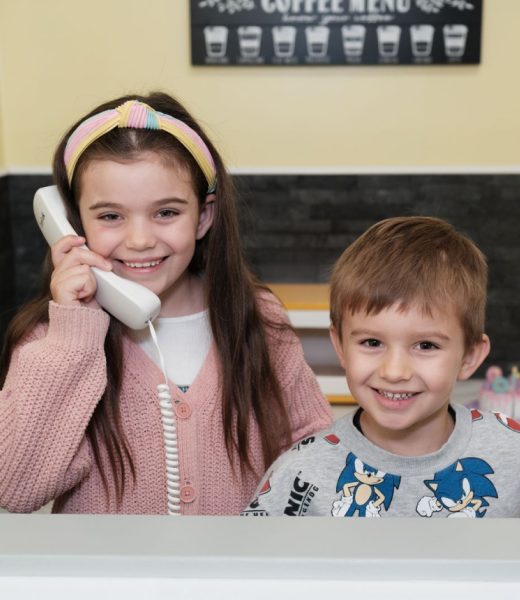
The good news is that siblings do not always need completely separate activities. With the right play ideas, children of different ages can enjoy time together while still learning, exploring and having fun in their own way.
Open-ended play works well for mixed-age siblings because there is no single right way to join in. Children can take the same activity and adapt it to their own age and ability.
Building blocks, soft play, role play, dressing up, craft materials and pretend food are all good examples. A younger child may stack blocks, while an older child builds a detailed structure. A toddler may pretend to make a cup of tea, while an older sibling creates a whole café menu.
This allows children to play together without one child feeling bored or left behind.
Role play is one of the best activities for mixed-age siblings because it naturally allows everyone to take on different roles. Children can pretend to run a shop, café, hospital, school, garage or home.
Older children often enjoy leading the story, while younger siblings can copy, join in and learn through observation. This helps build communication, imagination and social skills.
Simple props such as bags, toy money, hats, notebooks and pretend food can make role play even more engaging.
Soft play can be a helpful option for families with children of different ages. It gives children space to move, explore and play at their own pace.
Younger children can practise climbing, crawling and balancing in safer areas, while older siblings can enjoy more active play. Many children enjoy being able to play independently while still sharing the same environment.
For parents and carers, this can make days out easier because everyone has something to do in one place.
Book your soft play session today.
Friendly challenges can be a fun way to bring siblings together. The key is to make sure the challenge can be adapted for different ages.
For example, you could ask children to build the tallest tower, create the funniest animal, complete a mini obstacle course or find five objects of a certain colour. Older children can take on a harder version, while younger children can join in at their own level.
Keep the focus on teamwork and fun rather than winning.
Crafts are a great mixed-age activity because children can work with the same theme in different ways. For example, you could ask everyone to make an animal, design a birthday card or decorate a paper crown.
Younger children may enjoy sticking, colouring and mark-making, while older children can cut, design and add more detail. Giving children freedom over their own creation helps avoid comparisons.
Make sure materials are age-appropriate, especially if younger children are still likely to put things in their mouths.
Some activities are perfect for encouraging siblings to work together. They could build a den, create a pretend shop, make a treasure map or put on a mini performance.
Older children can often help younger ones, which builds patience and confidence. Younger children benefit from watching and copying their sibling.
It is helpful to give each child a role so everyone feels included. One child might be the builder, another the decorator and another the customer or performer.
While sibling play is lovely, children also need space to do their own thing. Mixed-age siblings may not always want to play together, and that is completely normal.
Try setting up nearby activities so they can be close without needing to share everything. For example, one child could build while another colours, or one could enjoy role play while another reads.
The best mixed-age play is flexible, simple and open to imagination. Activities like soft play, role play, crafts, building and gentle challenges allow siblings to join in at their own level while still enjoying time together.
With the right approach, mixed-age play can help children build stronger bonds, practise social skills and create happy family memories.